Powdered Metal Casting Process


Brought to you by  

Wynn Danzur Marketing

http://www.wynndanzur.com

If link fails, cut and paste it to your browser.


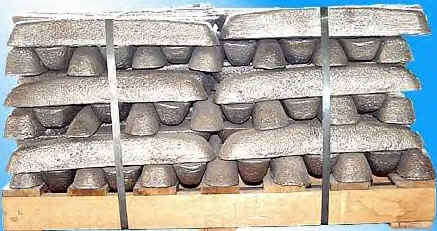
The above picture is your casting job, waiting to be poured!

Needing some help or ideas with your casting project, including a price quotation ?

We can send a Casting Plan to the privacy of your office, complete with confidential pricing information.  

For more information on Casting Processes use the Main Website with above link or, 

Send us e-mail at:  wynndanzurUSA1@aol.com


Other Casting Processes Available:

   aluminum castings   +   sand castings  +  powdered metal castings  +   shell mold castings   +  investment  castings   +   die castings   +   continuous  mold castings  +  permanent mold castings  +  V process castings  +  sand sling castings  +   green sand castings  +  lost foam castings  +   steel castings   +   grey iron castings  +  

***************************


                The Powdered Metal        

                    Casting Process


                The three basic steps

            for producing components

 by the Powder Metal Casting Process are: 

       Mixing, Compacting, and Sintering.


  Cost Benefits with Powdered Metal 

  • Eliminates or minimizes machining.
  • Great Economies for both Tooling and Piece Part Pricing in proper applications
  • Eliminates or minimizes scrap losses.
  • Maintains close dimensional tolerances.
  • Achieves a wide variety of alloy systems.
  • Produces good surface finishes.
  • Provides materials which may be heat-treated for increased strength or enhanced wear resistance.
  • Provides controlled porosity for self-lubrication or filtration.
  • Facilitates manufacture of complex or unique shapes which would be impractical or impossible with other metalworking processes.
  • Suited to moderate-to-high volume component production requirements.
  • Offers long-term performance reliability in critical applications.


  Manufacturing considerations for your Business

        1. Complex shape capability.

        2. Cost reductions for both Tooling and Piece Part Pricing 

        3. Minimized expensive powder input.

        4. Minimized material removal in making complex shapes.

        5. Applicability to difficult-to-compact materials.

        6. Highly effective compaction, usually without need for binders. 

          7. Ability to make a near-net shape.

           8. Uniform density and properties.


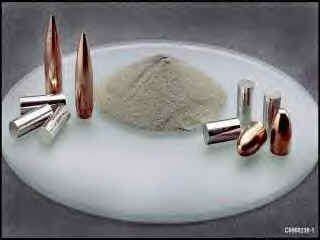
Below is an example of the vast range for applications with Powdered Metal Components

Engineers at Oak Ridge National Laboratory (ORNL) are using powder metal techniques to produce metal matrix composite simulants for lead. Bullets are being fabricated from mixtures of powdered metals, and/or coated metal powders or particulates that are consolidated to form dense metallic materials. 


                                     Photo Courtesy of Oak Ridge National Laboratory

Application Ideas

P/M parts are used in many products such as automobiles, home appliances, power tools and hardware, riding lawn mowers and farm equipment, business machines and sporting goods, just to mention a small amount of applications.


How P/M Parts Are Made

Typical parts can be produced at rates of several hundred to thousands per hour with the P/M process. Although normally associated with high volume production, P/M also is feasible for economic part production in lower volumes. 

For maximum efficiency, however, lower volume parts should be comparatively simple, permitting low tooling and maintenance costs. Also, extending tooling use to produce more than one part, such as in varying thickness or a common part with different size holes, will enhance the low volume economic rationale for P/M. 

Another consideration is that the part design should take advantage of the ability of the P/M process to minimize secondary processing operations in comparison to these requirements if the part were to be produced by competitive methods. 

When these factors are implemented, P/M parts often offer cost and performance advantages in runs as low as 1,000 pieces.


The Fundamentals of Powder Metal Casting

No method of producing parts is perfect; no solution covers all problems. 

Powder Metal Casting (P/M) has solved literally thousands of design problems. Some solutions are simply a matter of a comparable part to other processes at less cost or with less wasted material. 

Powder Metal is a highly developed method of manufacturing reliable ferrous and nonferrous parts. Made by mixing elemental or alloy powders and compacting the mixture in a die, the resultant shapes are then sintered or heated in a controlled-atmosphere furnace to  bond the particles. 

The P/M process is cost effective in producing simple or complex parts at or very close to final dimensions at production rates that can range from a few hundred to several thousand parts per hour. As a result, only minor, if any, machining is required. P/M parts also can be sized for closer dimensional control that essentially eliminates secondary fabrication steps and/or coined for both higher density and strength.

In addition, ferrous and nonferrous P/M parts can be oil impregnated to function as self-lubricating bearings; resin impregnated to seal interconnecting porosity; infiltrated with a lower melting point metal for greater strength and shock resistance; and heat treated and plated when required.

Most P/M parts weight less than fractions of ounce, to pounds (2.27 Kg), although parts weighing as much as 35 pounds (15.89 Kg) can be fabricated in conventional P/M equipment. Many of the early P/M parts, such as bushings and bearings, were very simple shapes, as contrasted with the complex contours and multiple levels that are often produced economically today. In many cases, functions that normally would require intricate multiple parts and assembly steps are consolidated in a single P/M part that minimizes production procedures and reduces cost.

Since the P/M process is not shape sensitive and normally does not require draft, parts like cams, gears, sprockets and levers are very economically produced. In many cases, designs require that parts such as a cam and gear, or a spur gear and a pinion gear, be joined together by a secondary assembly method. These additional assembly steps very often can be eliminated with multiple level designs that combine the separate shapes into a one-piece P/M part. In other instances, two P/M parts may be assembled after pressing, then bonded into a one-piece part during sintering.

The basic versatility of P/M is applied in numerous industries, including automotive, business machines, aerospace, electrical and electronic equipment, small and major appliances, agricultural and garden equipment, hand and power tools. Thousands of different cost-saving reliable P/M designs now serve these industries in a wide range of engineering applications that fall into two main groups. In one group are parts which are very difficult to make by any other production method. For example, parts of difficult-to-fabricate materials such as tungsten and molybdenum, or tungsten carbide, cannot be made efficiently by any other process. Also, porous bearings, filters and many types of hard and soft magnetic parts are exclusively products of the P/M process.

Another, and larger, application group consists of components where P/M is an effective alternative to machined parts, castings and forgings. P/M technology now is expanding into precision hot forging from sintered blanks and pre-forms, thus extending its capabilities to providing P/M parts with increased strength.

Advantages of the P/M Process:
  • Eliminates or minimizes machining.
  • Great Economies for both Tooling and Piece Part Pricing in proper applications
  • Eliminates or minimizes scrap losses.
  • Maintains close dimensional tolerances.
  • Achieves a wide variety of alloy systems.
  • Produces good surface finishes.
  • Provides materials which may be heat-treated for increased strength or enhanced wear resistance.
  • Provides controlled porosity for self-lubrication or filtration.
  • Facilitates manufacture of complex or unique shapes which would be impractical or impossible with other metalworking processes.
  • Suited to moderate-to-high volume component production requirements.
  • Offers long-term performance reliability in critical applications.


                 If any of these links fail to open, cut and paste them into your browser.

             Thank you for Visiting our mini-website, be sure to visit the Main Website at:

                                                  http://www.wynndanzur.com

                                          There are more Mini Websites to be found in the Main Website

                                   Visit the Powdered Metal Foundry

                                              Metco Industries,  Inc. http://www.metcopm.com                                                                                                            at:  

                                                            ***************

                                                                        All this is brought to you by 

 Wynn Danzur Marketing

                                 Submit your drawings and blue prints, information, and  receive a Personal           

                     Confidential Casting Plan, with Price Quotations, e-mail, Fax, Phone, or US  Mail to below.

                                                   E-Mail: wynndanzurUSA1@aol.com


Wynn Danzur Marketing

     P.O. Box  3548  
      Bright, Indiana  47025 - USA

     Phone 812-637-2971 - Fax 812-637-2976

  No material contained in this publication, is supported any by Warranty.
  Absolutely No Warranty is in anyway implied. 
  For details, see Copyright Notice/General Public License, in Glossary Section, the main website. 

Main Website

 http://www.wynndanzur.com


  02/18/04 01:03:44 PM